Inversion
The inversion searches for the layered profile whose theoretical curve best matches the picking.
The initial model
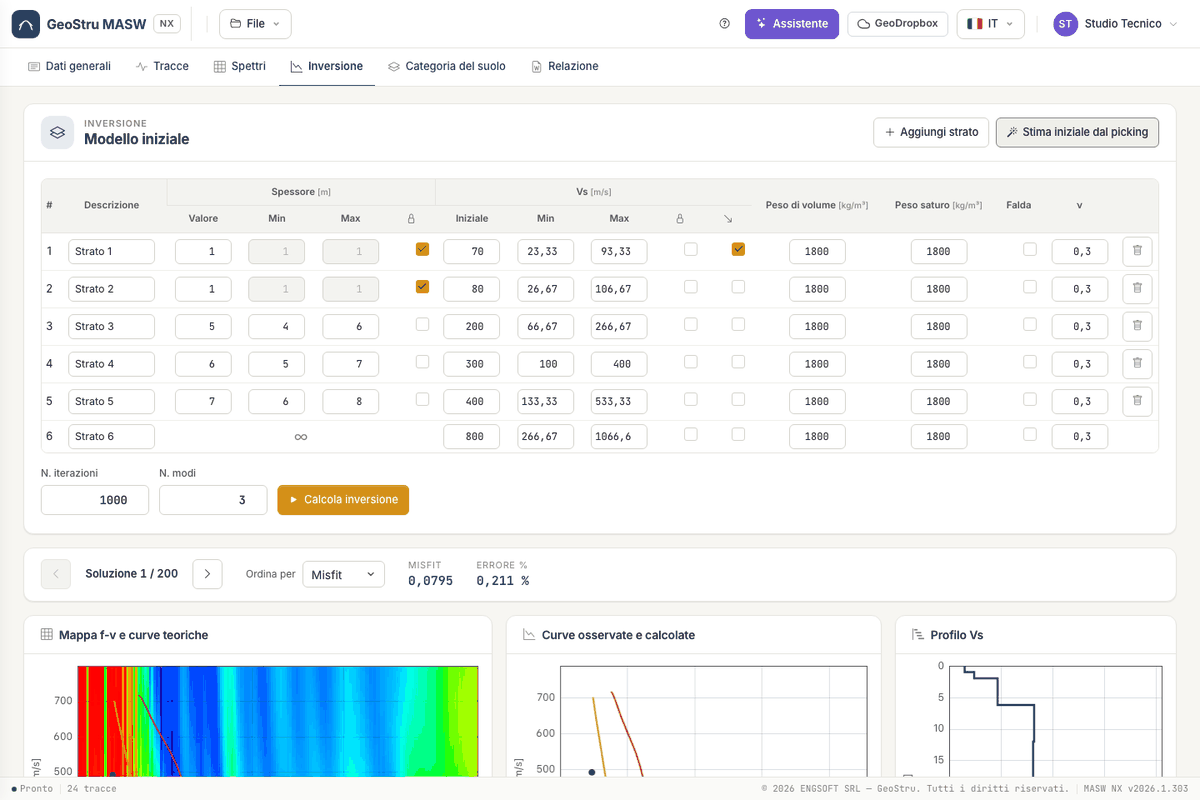
The table has one row per layer; the last is the half-space (∞). For each layer you set:
| Field | Meaning |
|---|---|
| Description | free text for the report |
| Thickness, Min, Max | value and bounds; with the lock it is not optimised |
| Initial Vs, Min, Max | value and bounds; with the lock it stays fixed |
| Increasing Vs | Vs does not decrease with depth |
| Unit weight, Saturated weight, Water table | used as density in kg/m³; with water table the saturated value applies |
| ν | Poisson's ratio: links Vp to Vs |
Stima iniziale dal picking (Initial estimate from picks) proposes Vs and bounds from the rule that a wave of length λ sees down to about λ/2. You can add and delete layers, up to 40.
The run
Set the number of iterations and modes, then Calcola inversione (Run inversion). You see the progress; Interrompi (Stop) ends the run and uses no credits.
The inversion is stochastic: two runs give slightly different solutions. Repeating the same run on identical data is not charged again.
Reading the solutions
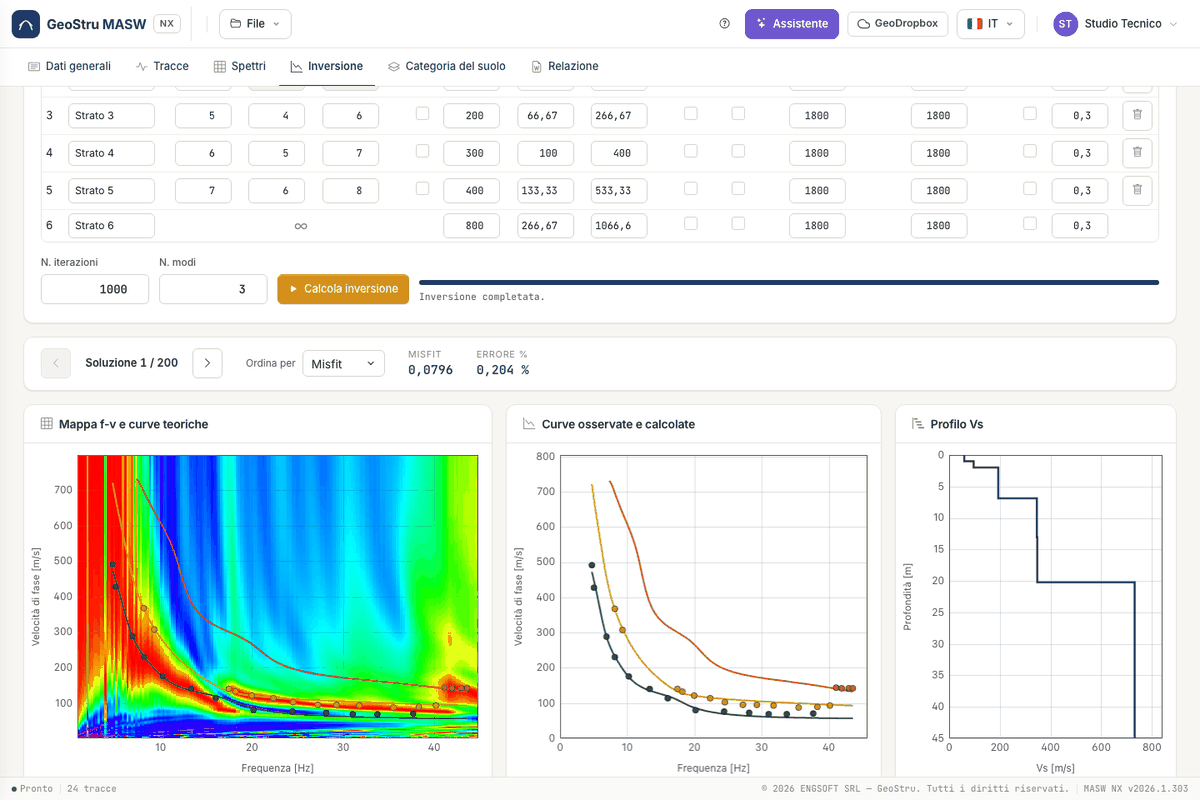
The browser steps through the models found, sorted by misfit or error %. For each one you see the map with theoretical curves, observed and calculated curves, the stepped Vs profile and the model table. The chosen solution is the one used by category and report.
Superseded results
If you change picks, layers, traces or filter after the inversion, a strip warns that results no longer match the data. The report is not generated until you run again.
Misfit is not truth
Different profiles can reproduce the same curve. Misfit measures agreement with the picks: geological judgement stays with you.
Found an error on this page? Let us know or open a Pull Request.