Reinforcements and archive
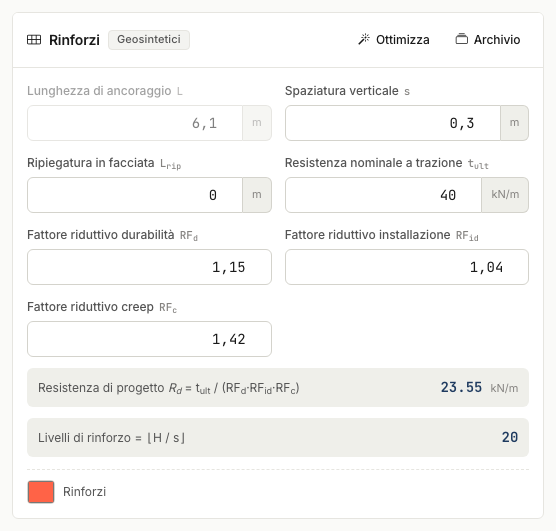
Reinforcement data
- Spacing s — vertical spacing; the levels are ⌊H/s⌋, at elevations z = s, 2s, … measured from the top (zero is at the crest).
- tult and the reduction factors RFd · RFid · RFc → design resistance Rd = tult/(RFd·RFid·RFc).
- L — anchorage length, used in the Check approach only.
- Lrip — fold of the wrap-around facing: a construction detail drawn in 2D/3D and mentioned in the report (0 = no wrap-around).
Reinforcement archive
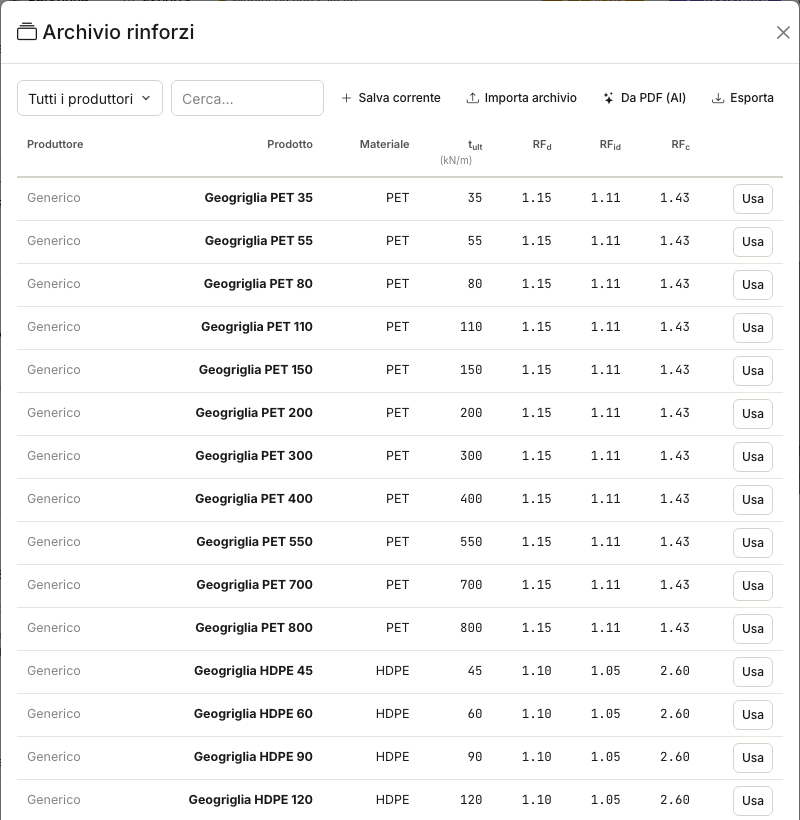
The Archive button opens the catalogue (generic PET/HDPE classes) and your personal archive: save the current values, import/export .json archives, or extract the products from a manufacturer data sheet in PDF with the AI assistant (a credit action) — ideal with certificates reporting tult and the reduction factors. Choosing Use fills in tult and RF, and the commercial name stays in the project and in the report (it is cleared if you edit the values by hand).
Indicative values
The strengths and reduction factors of the built-in archive are indicative: always check the manufacturer's data sheets and certificates.
Results level by level
For each level the table shows: action A = (γ·z·Ka + Δq)·s, total and effective length, pullout resistance Rsfil = 2·(γ·z+Δq)·tanδ·Leff, design resistance and the factors FSsfil = Rsfil/A and FSrott = Rd/A.
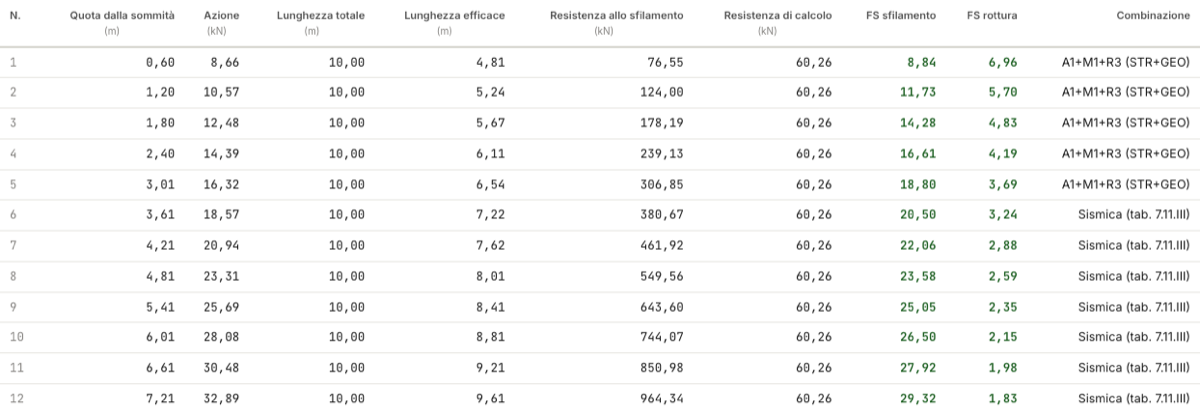
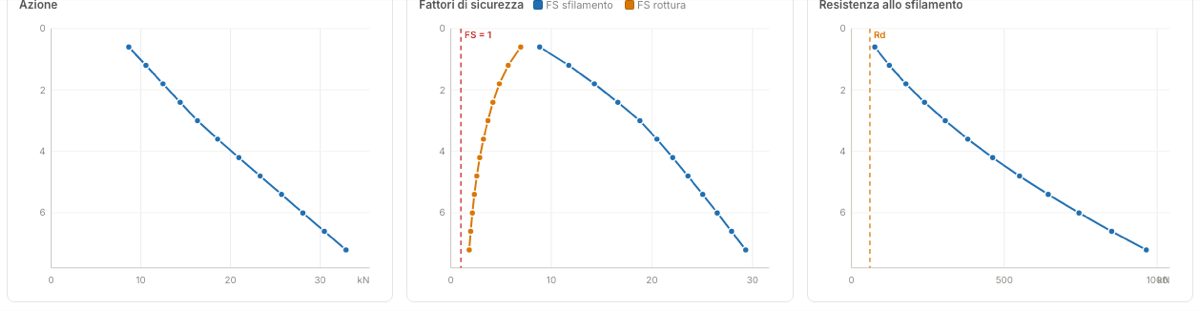
With more than one combination the default view is the design envelope (per level: the combination with the lowest FS and the largest length); the three charts below the table — action, factors of safety with the FS = 1 threshold, pullout resistance with the Rd line — also go into the report.
Found an error on this page? Let us know or open a Pull Request.