Areas and calculation methods
Drainage areas
Each row of the table is a surface that is homogeneous in use and permeability. You need a description, the type, the area in m² and the post-development runoff coefficient φ.
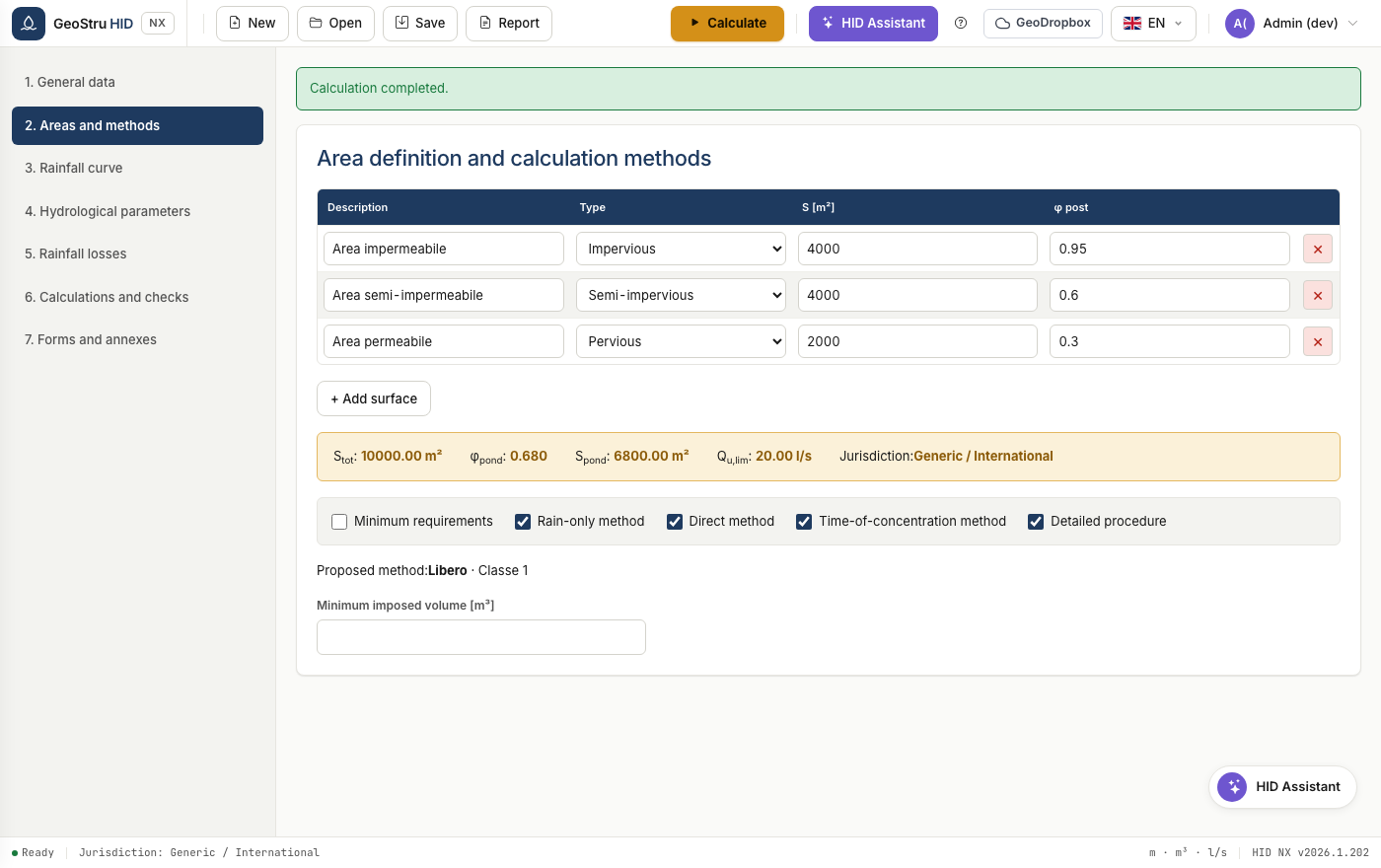
The area type (impervious, semi-impervious, pervious) is a descriptive label that suggests the order of magnitude of φ; the value used in the calculation is always the one you type.
HID calculates the weighted runoff coefficient:
and the weighted area \(S_{pond} = S_{tot} \cdot \varphi_{pond}\), which is the equivalent impervious area.
The sizing methods
HID distinguishes universal methods, valid everywhere, from jurisdiction methods, which exist only where the regulation prescribes them.
Minimum requirements
Specific volume per hectare imposed by the regulation as a function of the hydraulic criticality zone. In Lombardia it is 800, 500 or 400 m³/ha depending on zone A, B or C and on the regulation version. Where the regulation does not prescribe it, you set the minimum volume yourself.
Rain-only method
It balances the inflow volume against the volume discharged at constant flow, looking for the duration that maximises the storage. It is the most widely used method for quick checks.
Durations shorter than one hour
When the critical duration drops below one hour, HID uses the exponent n₁ of the curve, as required. It does not round the duration up to one hour: doing so underestimates the volume, and it is an error we corrected while validating the app against the previous version.
Time-of-concentration method
It introduces the catchment time of concentration, so it accounts for the shape of the hydrograph. It returns the critical duration and the volume.
Direct method
It compares the specific pre- and post-development storage volumes through the ratio of the runoff coefficients. In Emilia-Romagna and Marche the regulation prescribes a variant with fixed coefficients, which HID exposes as a separate method, Regional direct method, visible only in those regions.
Detailed procedure
This is the full simulation: design hyetograph, losses, flood hydrograph and step-by-step attenuation of the storage facility. It is the most demanding method and the most defensible.
How the volume is chosen
HID calculates all the selected methods and adopts the highest result as the allowable volume. The method proposed by the regulation is shown below the checkboxes, but it does not limit which methods you can calculate.
Found an error on this page? Let us know.