Code and seismic action¶
Step 8 has three panels: Code and analysis options, Site seismic parameters and Wall seismic coefficients.
Code and analysis options¶
| Field | Choices |
|---|---|
| Geotechnical code | D.M. 1996 allowable stress, D.M. 1996 limit states, OPCM 3274, NTC 2008, Eurocodes, STAS 3300, BS 8004, SR EN 1997-1, NTC 2018 |
| Structural code | D.M. 1996 allowable stress, D.M. 1996 limit states, OPCM 3274, NTC 2008, Eurocode 2, STAS 10107, BS 8110, SR EN 1992-1-1, NTC 2018 |
| Section checks | Limit states, Allowable stress |
The geotechnical code decides the combinations and the partial factors (see Combinations and checks). The list is the one of the desktop, because imported projects keep their code; the first release computes with NTC 2018, NTC 2008 and the Eurocodes. With the other codes the app shows a warning; calculation with the historical codes is coming.
Below the code, the analysis options:
| Group | Field | Choices and unit |
|---|---|---|
| Earth pressure | Condition | At rest, Active |
| Method | Rankine, Coulomb / Mononobe-Okabe | |
| Seismic increment application point | at 2/3 of the height from the base, at 1/3, at mid-height | |
| Passive thrust share | % (0 to ignore it) | |
| Wall friction δ also on the virtual plane (instead of δ = φ) | checkbox | |
| Bearing capacity | Method | Vesic, Hansen |
| Exclude shape, inclination, depth factors | checkboxes | |
| Base friction angle | ° (0 = from the founding layer) | |
| Base adhesion | kPa (0 = from the founding layer) |
With D.M. 1996 allowable stress the Required safety factors group also appears (overturning, sliding, bearing capacity); with limit state codes the minimum is 1. The formulas are in Earth pressure and seismic action and Global checks.
Note
Base friction and adhesion typed by hand are reduced with the factors γφ and γc of the combination, like the layer parameters. The desktop program used them unreduced.
Site seismic parameters¶
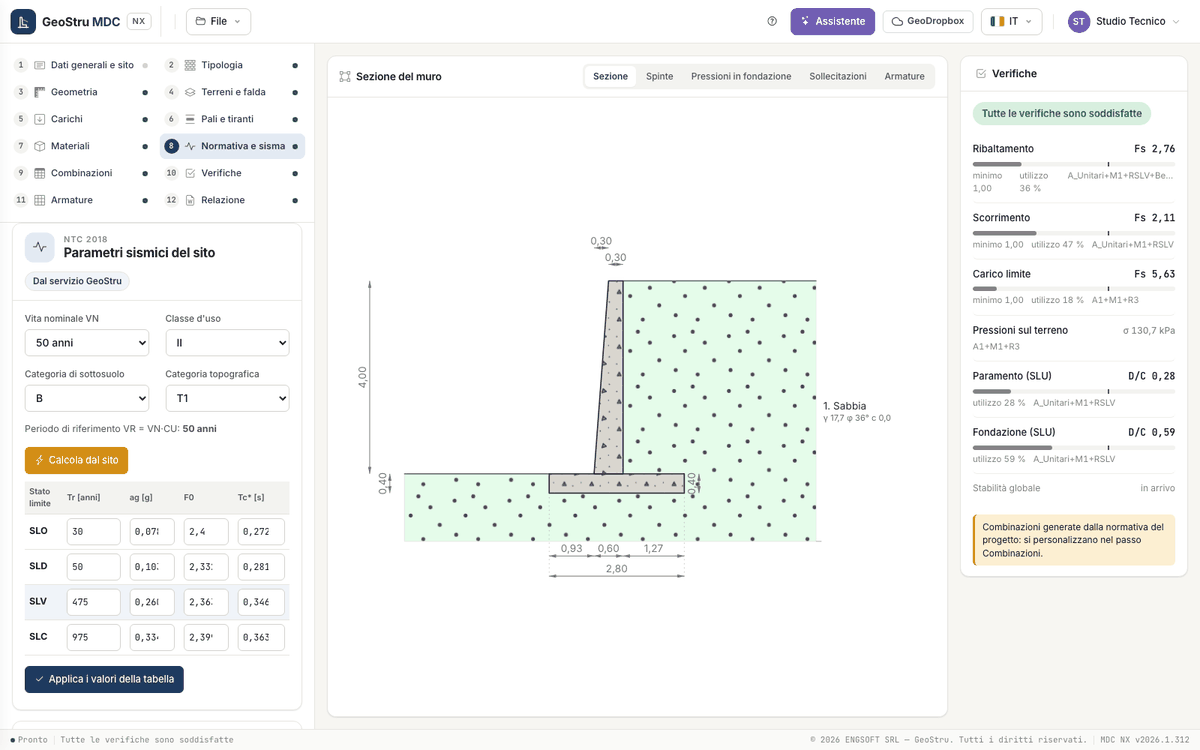
| Field | Choices |
|---|---|
| Nominal life VN | 10, 50, 100 years |
| Use class | I, II, III, IV |
| Subsoil category | A, B, C, D, E |
| Topographic category | T1, T2, T3, T4 |
The step shows the reference period VR = VN·CU, which sets the return periods. Calculate from the site queries the GeoStru Seismic Parameters service with the coordinates of the General data and site step and fills the table of the four limit states (SLO, SLD, SLV, SLC) with TR [years], ag [g], F0 and Tc* [s]. Without coordinates the button is disabled and a link leads to step 1.
The values can also be typed or corrected in the table and stored with Apply the table values. The label at the top tells where they come from: "From the GeoStru service", "Entered by hand", "From the file" or "No parameters". If you change nominal life or use class, the parameters taken from the service were valid for other return periods: the app removes them and asks you to compute them again.
Wall seismic coefficients¶
| Field | Notes |
|---|---|
| Horizontal coefficient kh | |
| Vertical coefficient kv | |
| Wall that does not allow displacements | βm = 1 |
k_h and k_v from the site parameters (ULS-LS) computes the two coefficients from the SLV limit state and writes them in the fields; they can also be typed by hand. Below, a table per limit state shows SS, ST, amax, βm, kh and kv:
| Quantity | Value |
|---|---|
| SS (stratigraphic amplification) | A 1; B 1.40 − 0.40·F0·ag/g between 1 and 1.2; C 1.70 − 0.60·F0·ag/g between 1 and 1.5; D 2.40 − 1.50·F0·ag/g between 0.9 and 1.8; E 2.00 − 1.10·F0·ag/g between 1 and 1.6 |
| ST (topographic amplification) | T1 1.0; T2 1.2; T3 1.2; T4 1.4 |
| βm (NTC 2018 §7.11.6.2.1) | 0.38 at SLV, 0.47 at SLD; 1 if the wall does not allow displacements |
In the combinations¶
With the combinations generated from the code, kh and kv of the wall go into the seismic combinations by themselves: no need to copy them. In the NTC 2018 seismic combination for overturning (EQU) the program increases them by 50 % (at most 1), as the code requires.
The vertical seismic action has a single direction: the inertia force kv·W acts upwards on the masses, which is the unfavourable direction for the global checks.
Warning
In the desktop program the NTC 2018 seismic combinations were created with kh = 0 unless the seismic action was computed again: the calculation was static without the user knowing. In MDC NX the seismic combinations always take the wall coefficients. Check in the Load combinations step that kh is not zero.
Coming soon¶
Permanent displacements of the wall (Newmark, Richards-Elms) and seismic capacity (limit PGA) come with the second release.
Found an error on this page? Let us know or open a Pull Request.