Micropiles
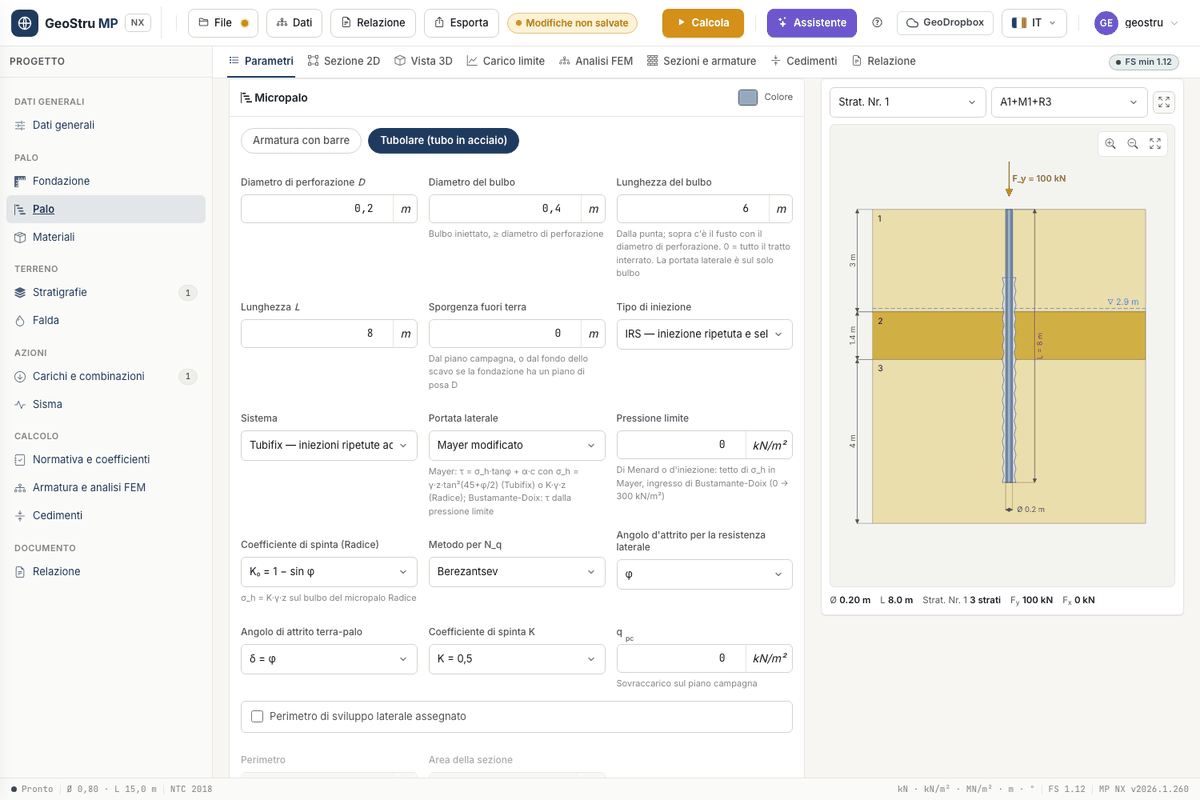
In General data choose the Type Micropile: the Pile card takes the title Micropile and shows the fields for the bulb, the system and the method. The calculation uses the dedicated micropile routine of the MP desktop program, not the bored-pile one.
Geometry and system
| Field | Meaning |
|---|---|
| Drill diameter D | diameter of the shaft above the bulb |
| Bulb diameter | grouted bulb, greater than or equal to the drill diameter |
| Bulb length | measured from the toe; 0 = whole embedded length |
| Length L, Protrusion above ground | as for the pile |
| Grouting | IGU (single global grouting) or IRS (repeated selective grouting) |
| System | Tubifix (repeated high-pressure grouting) or Radice (gravity or low-pressure grouting) |
| Shaft resistance | modified Mayer or Bustamante & Doix |
| Limit pressure | Menard or grouting pressure, in kN/m² |
| Earth pressure coefficient (Radice) | K0 = 1 − sin φ, Ka or Kp |
At the top of the card you choose the reinforcement: Bar reinforcement or Tubular (steel tube).
How the capacity is computed
The shaft resistance is computed on the bulb only, integrating the shear stress in 10 cm steps along its length.
- Modified Mayer: τ = σh·tan φ + α·c. For the Tubifix system σh = γ·z·tan²(45° + φ/2), capped by the limit pressure when you assign it. For the Radice system σh = K·γ·z, with K chosen among K0, Ka and Kp.
- Bustamante & Doix: τ depends on the limit pressure plim. In frictional soils τ = plim/10; in cohesive soils a linear correlation in plim applies, different for IRS and IGU grouting. If the limit pressure is 0 the program assumes 300 kN/m².
The base resistance is computed on the bulb diameter, with Nq and Nc of the chosen method and the overburden stress at the toe. The weight adds the grout of the shaft, the grout of the bulb and the reinforcement per metre. Broms' ultimate lateral load works on the bulb, with γ, φ and c averaged over the layer thicknesses.
Adhesion α and cohesion c (or cu in undrained layers) come from the stratigraphy.
The tube
With Tubular the Materials and reinforcement card shows the Tube block:
- Series diameter and Series thickness offer the UNI EN 10220 dimensional series. The choice writes Tube outer diameter, Tube thickness and Reinforcement weight, which stay editable for an off-series tube.
- The Reinforcement weight, in kN/m, comes from the tube geometry (0.02466·t·(D − t) kg/m) and adds to the grout weight.
- Tube steel picks the grade from the tube-steel archive: S235…S460 grades of EN 10210/10219, EN 10297-1 mechanical tubes, API 5CT and API 5L tubulars. The design strength is fyd = fyk/1.05. The archive is edited like the other materials.
- Cover is the grout thickness between the tube and the drill hole.
My of the composite section
Broms needs the ultimate moment of the section, My. If you leave it at 0, for the tubular micropile the program computes the full-plastic moment of the composite tube + grout section at zero axial force: tube steel at fyd, grout in compression at fcd of the chosen concrete class. If the solver does not converge it uses the plastic moment of the tube alone, Wpl·fyd, and reports it among the messages.
The composite moment can be lower than that of the tube alone
In the DPHS1 example the composite section gives 39.68 kNm against 42.70 kNm for the tube alone. With the grout in compression the neutral axis rises and the steel in compression decreases more than the grout makes up for. It is the value of the desktop program, reproduced and declared.
If you assign My by hand, your value prevails. In the FEM model the inertia is the equivalent tube + grout one, transformed with Es/Ec, unless you assign J.
What is not available
- The node-by-node ULS check of the composite tube + grout section: the Sections and reinforcement tab shows the notice "Tubular section check not available". The FEM is run anyway.
- Micropile networks and raked micropiles.
- The critical buckling load of the micropile.
- Settlement with Fleming's hyperbolic method: the settlement is that of Poulos and Davis.
Found an error on this page? Let us know or open a Pull Request.